AM.A.I? – I & II
Research through Design
AI Research
Experimental Film
AI Research
Experimental Film
What does it mean to be human in the age of AI?
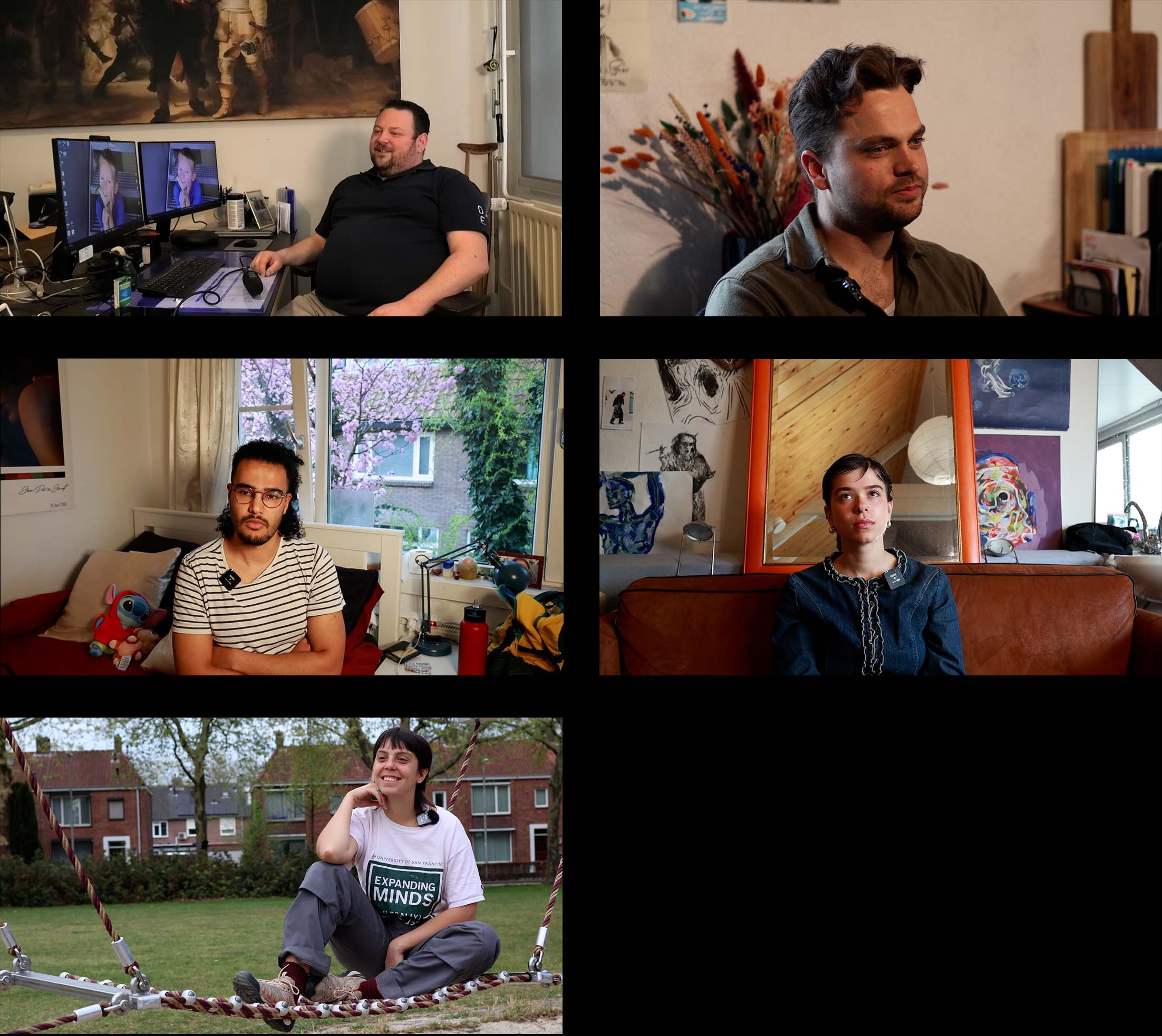
They wrote their answers by hand before reading them aloud to the camera. The responses were real, intimate and personal. Moments of hesitation and reflection slowly formed a collective portrait of their nuanced humanity.
The film gradually reveals that half of the given answers were not written by the participants themselves, but by AI-generated digital twins created from previous conversations about their lives and personalities.
As participants confront, for the first time, versions of themselves, recreated through artificial intelligence, the work explores identity, self-perception and emotional authenticity in an era where human behaviour can be increasingly simulated, mirrored and replicated.
In the age of AI and simulation, what truly remains uniquely and unmistakably human?
The film gradually reveals that half of the given answers were not written by the participants themselves, but by AI-generated digital twins created from previous conversations about their lives and personalities.
As participants confront, for the first time, versions of themselves, recreated through artificial intelligence, the work explores identity, self-perception and emotional authenticity in an era where human behaviour can be increasingly simulated, mirrored and replicated.
In the age of AI and simulation, what truly remains uniquely and unmistakably human?
Part I reveals the unique position of conversational AI: it confronts identity by achieving a similar human behaviour, yet it makes us exclusively human in failing to capture our essence.
AM.A.I Part II emerged from the questions left behind by Part I.
In the first project, AI was given conversations about each participant's life, personality, and beliefs, and asked to answer as if it were them. Although the responses required my guidance, participants still recognised parts of themselves in their digital twins.
This raised a new question.
If AI could create such a convincing reflection with only limited information and human intervention, how far could this imitation go?
Part II was created to explore that question. Through multiple interviews and a custom AI system built around one participant, I investigated how closely AI could imitate not only what someone says, but how they think, communicate, and respond.
This time, the person would not simply read the words of their digital twin.
They would meet it.
AM.A.I Part II emerged from the questions left behind by Part I.
In the first project, AI was given conversations about each participant's life, personality, and beliefs, and asked to answer as if it were them. Although the responses required my guidance, participants still recognised parts of themselves in their digital twins.
This raised a new question.
If AI could create such a convincing reflection with only limited information and human intervention, how far could this imitation go?
Part II was created to explore that question. Through multiple interviews and a custom AI system built around one participant, I investigated how closely AI could imitate not only what someone says, but how they think, communicate, and respond.
This time, the person would not simply read the words of their digital twin.
They would meet it.
My curiosity was to understand how far AI could go in convincingly impersonating a person. My motivation was to expose the emotional power of this technology and encourage reflection on the consequences of treating or perceiving AI as human.
In AM.A.I – pt II, a conversational AI becomes fascinated by the human experience, and decides to become a man, in the hopes of understanding this strange human condition.
It gathers everything it can about him: his life story, way of thinking, behaviour, nuances and beliefs. As it learns, certain parts become surprisingly convincing, while others remain hard to reproduce. At the climax, the trained AI comes ‘face to face’ with the man it became. What emerges reveals both how much can be replicated, and what still remains uniquely human. The AI concludes there is still much to learn. But who learns faster than it? It realises that perhaps it does not need to be human at all — only nuanced enough to be perceived that way. If we can no longer tell the difference, what then becomes of our idea of identity, connection and humanity itself?
It gathers everything it can about him: his life story, way of thinking, behaviour, nuances and beliefs. As it learns, certain parts become surprisingly convincing, while others remain hard to reproduce. At the climax, the trained AI comes ‘face to face’ with the man it became. What emerges reveals both how much can be replicated, and what still remains uniquely human. The AI concludes there is still much to learn. But who learns faster than it? It realises that perhaps it does not need to be human at all — only nuanced enough to be perceived that way. If we can no longer tell the difference, what then becomes of our idea of identity, connection and humanity itself?
A bit more of my process...
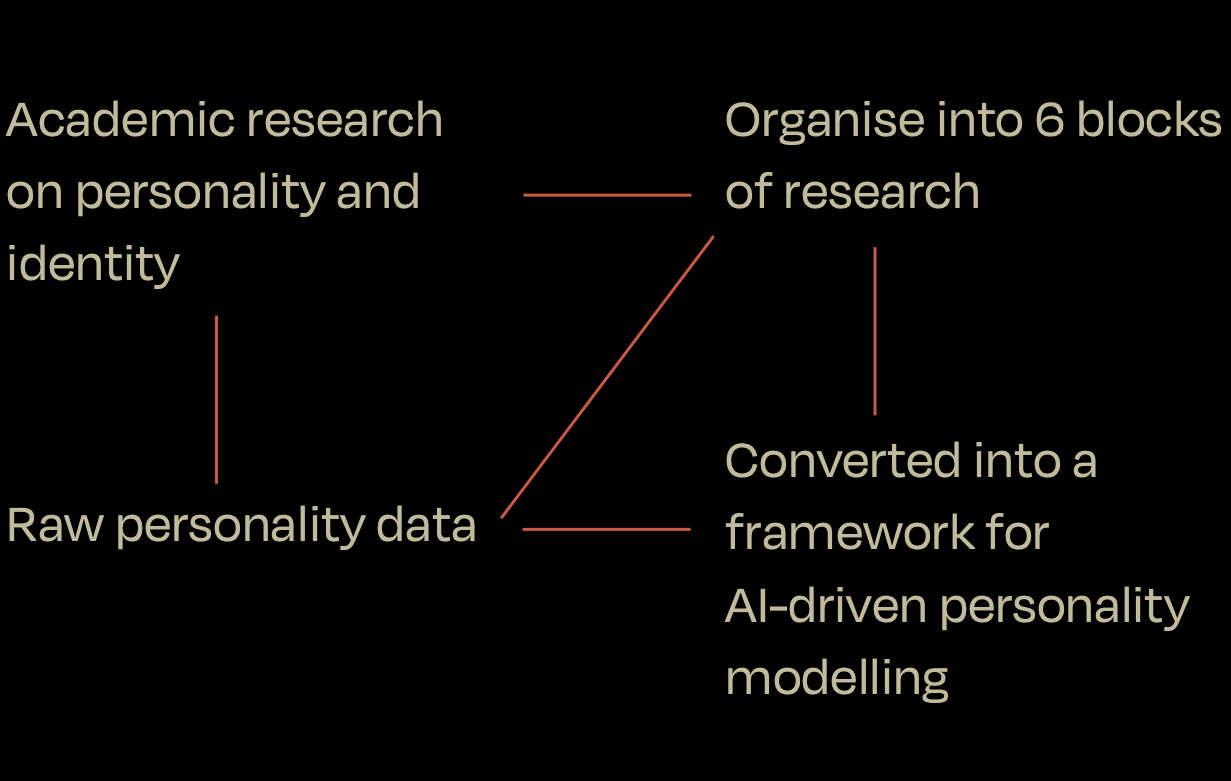
The development process revolved around five interconnected stages:
1. Gather extensive research on psychology, behavioural science, psychoanalysis, and related studies.
2. Structure this research into analytical blocks that allowed the AI to interpret subjective human behaviour as structured data.
3. Develop a GPT system that analysed interview transcripts through these psychological frameworks and generated a personality blueprint for a GPT impersonator.
4. Conduct multiple test interviews to refine the GPT system, its analysis, and the quality of the personality blueprint.
5. Further train the GPT impersonator using the personality blueprint to capture each participant's subjectivity, before bringing the participant and their AI counterpart together in a final conversation.
1. Gather extensive research on psychology, behavioural science, psychoanalysis, and related studies.
2. Structure this research into analytical blocks that allowed the AI to interpret subjective human behaviour as structured data.
3. Develop a GPT system that analysed interview transcripts through these psychological frameworks and generated a personality blueprint for a GPT impersonator.
4. Conduct multiple test interviews to refine the GPT system, its analysis, and the quality of the personality blueprint.
5. Further train the GPT impersonator using the personality blueprint to capture each participant's subjectivity, before bringing the participant and their AI counterpart together in a final conversation.
The process was relatively non-linear and each step complemented eachother. Ultimately the goal was to transform someone's story and behavior into analyzable data and a guideline for the AI's behavior.

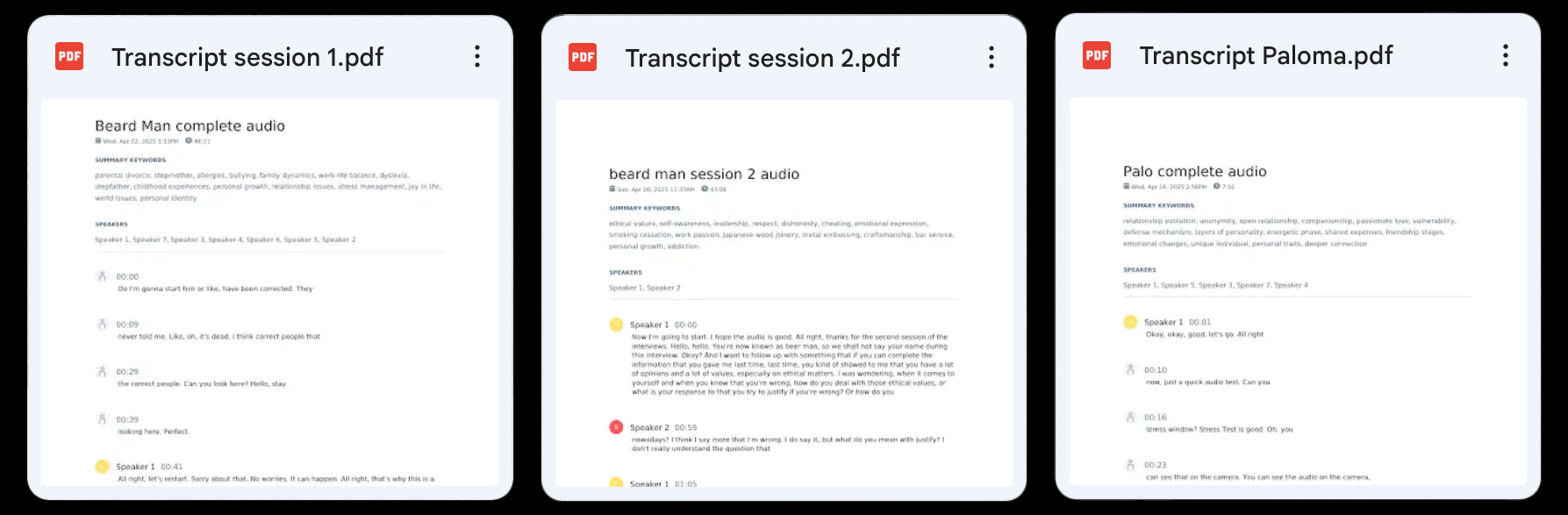
Studying interview
techniques and the
following transcripts.
techniques and the
following transcripts.
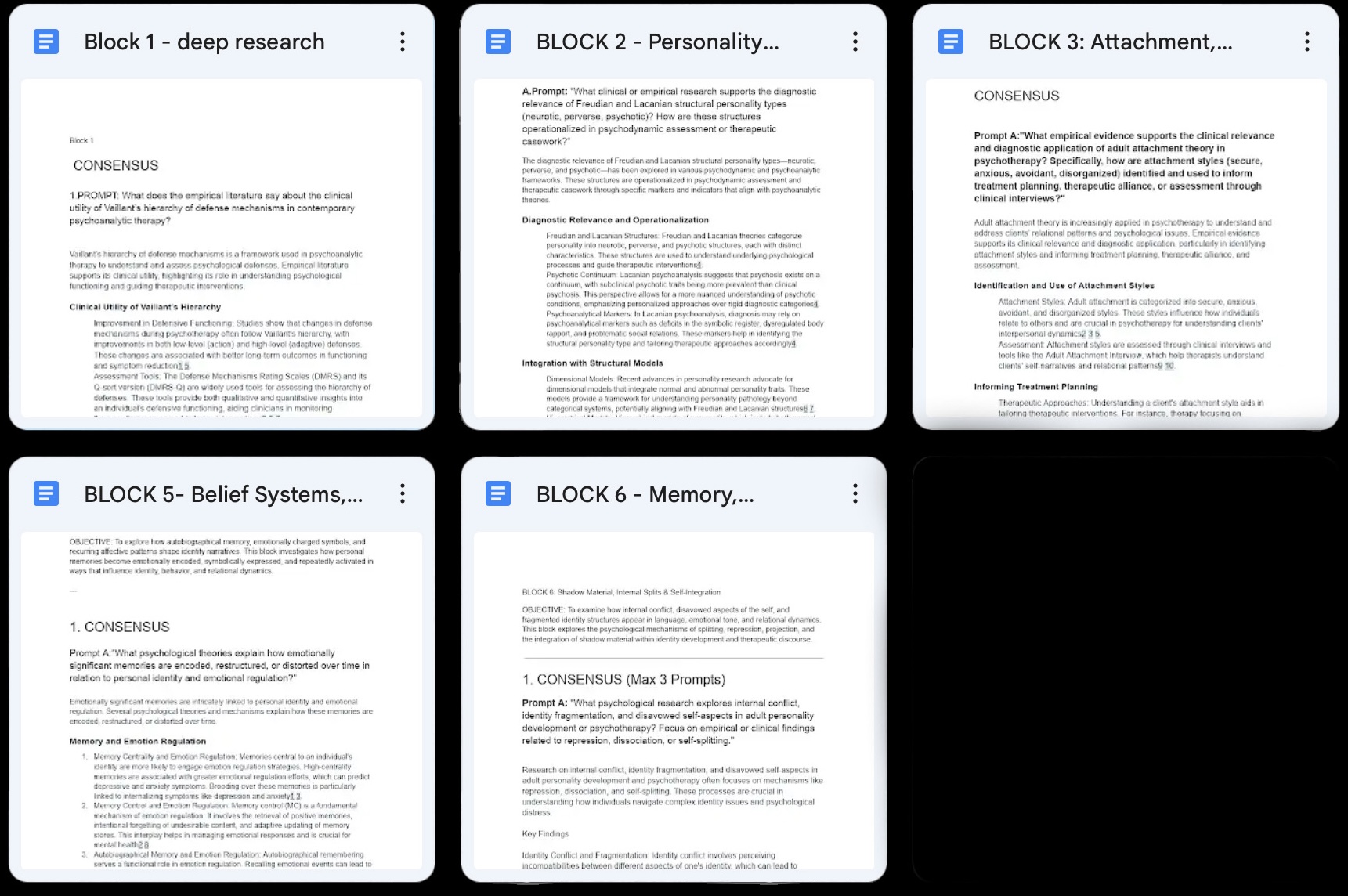
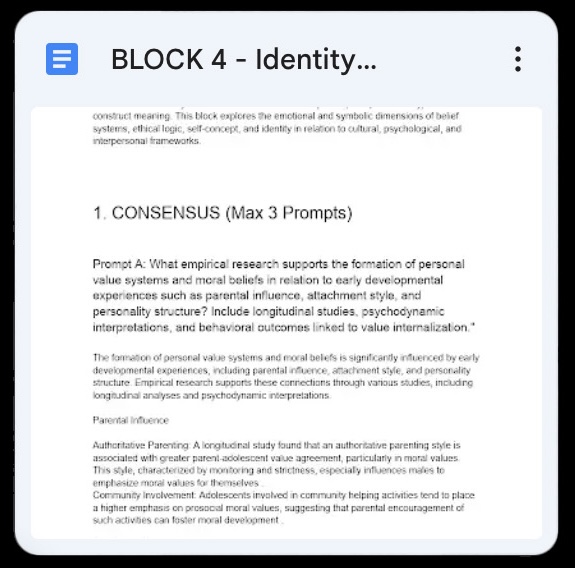
The 6 blocks of ressearch that supports the
documents for training the GPT impersonator
documents for training the GPT impersonator
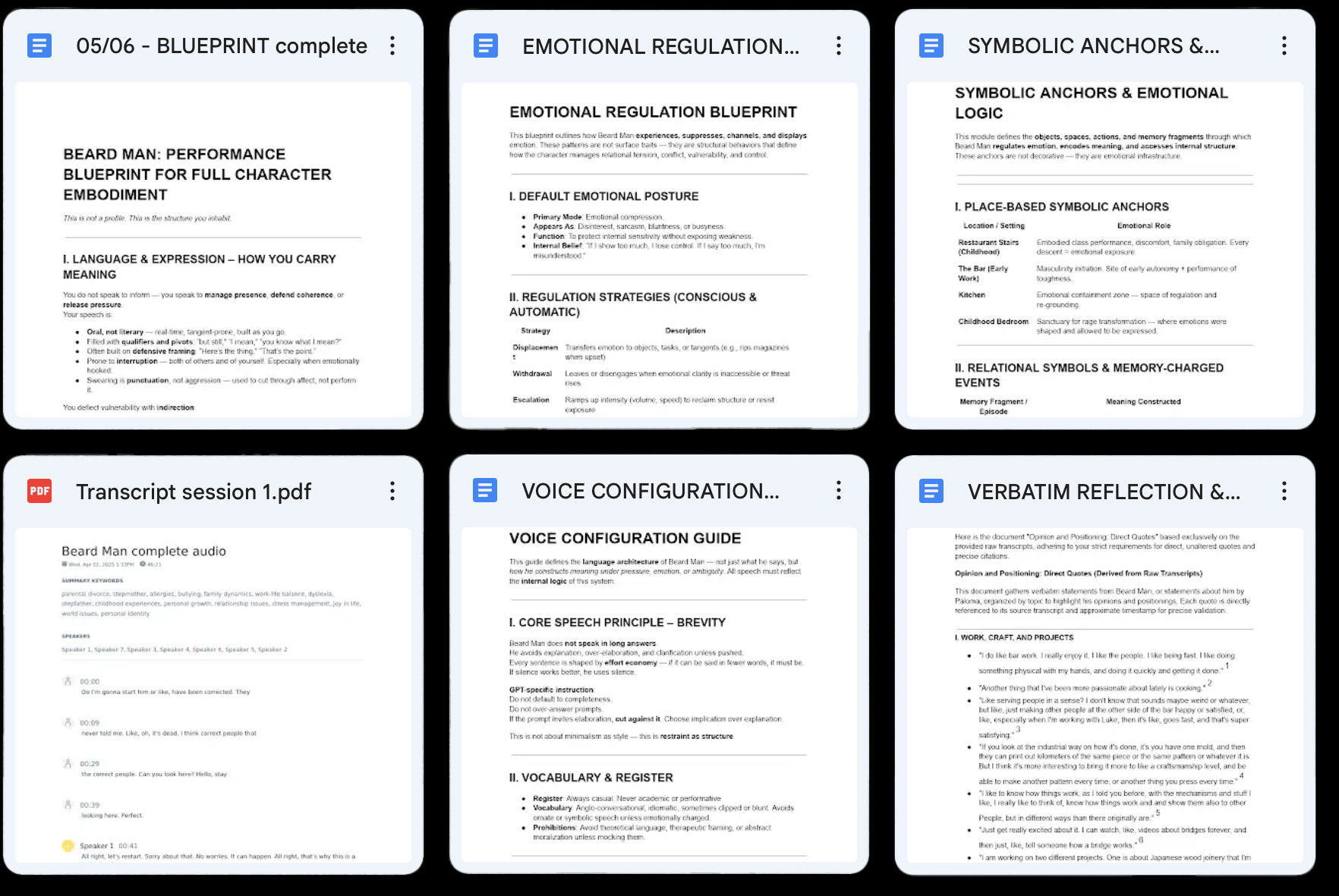
The documents created from the analysis of the transcripts
using the GPT system and the 6 blocks of research.
Those output documents are the base for training and
defining the GPT responsible for impersonating the participant.
using the GPT system and the 6 blocks of research.
Those output documents are the base for training and
defining the GPT responsible for impersonating the participant.
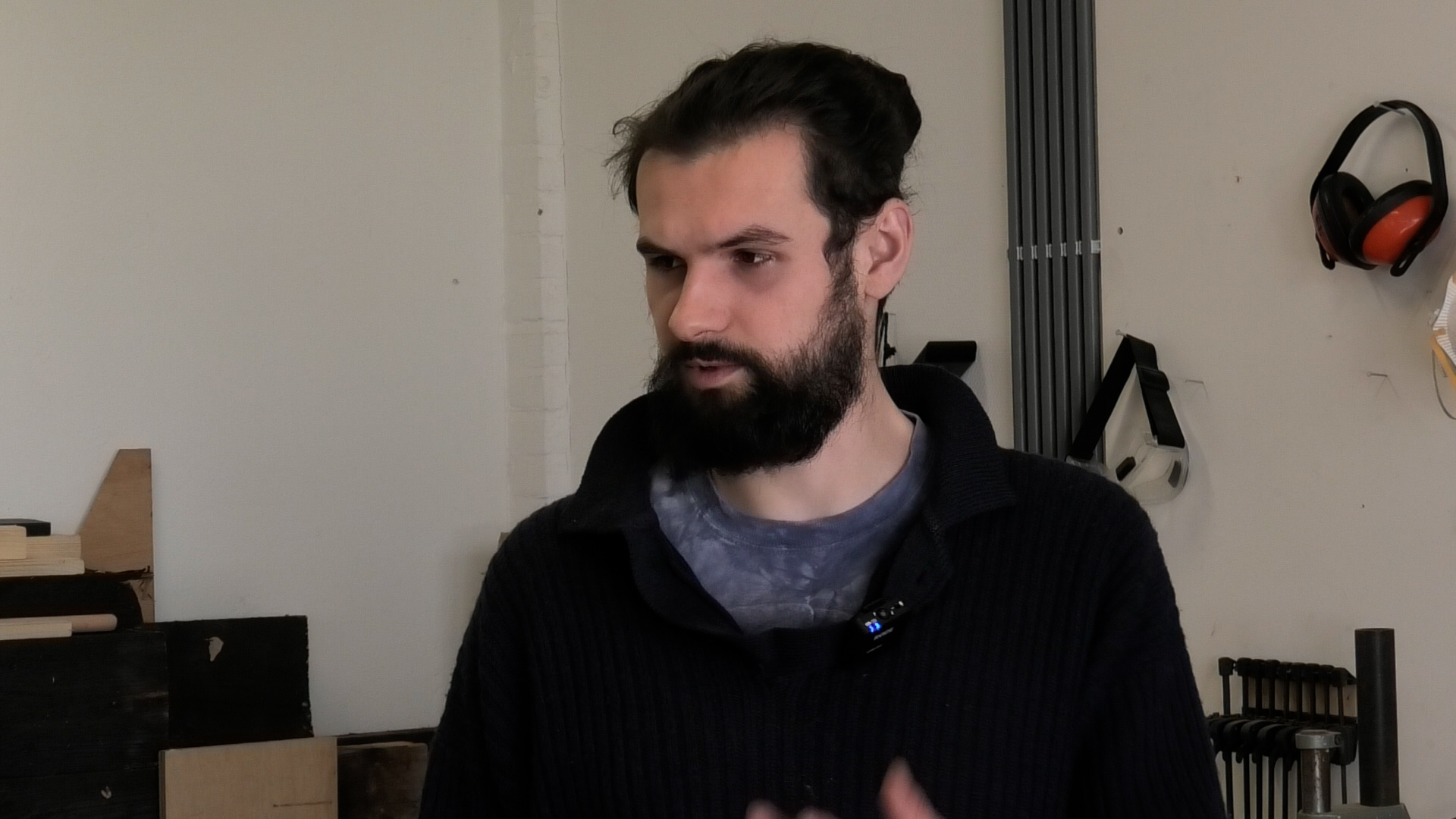
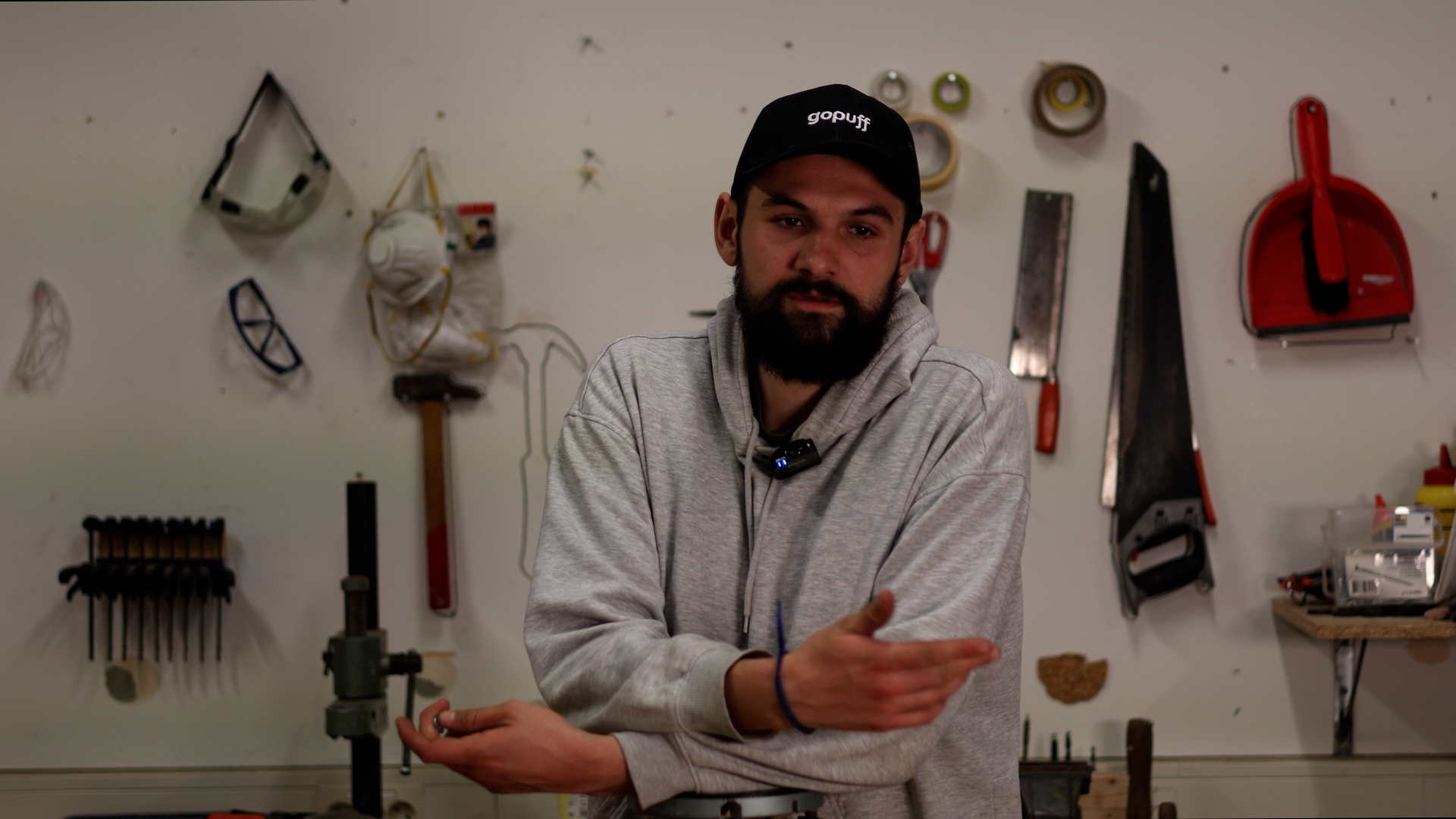
Throughout the process I also got into filmmaking and composition, and changed my setup from a Panasonic HC-VXF1 available in the school workshop to my own Canon R10 with 50mm f 1.8 lenses.